


Why Your San Francisco AC Struggles During Sudden Heat Waves (And How to Fix It)

When Historical Coastal Climates Meet Modern Heat Domes
At Air Flow Pros Heating & Air Conditioning, our technicians see firsthand that nearly 75% of residential cooling failures in Northern California happen during extreme, uncharacteristic temperature spikes. Understanding why your San Francisco AC struggles during sudden heat waves (and how to fix it) usually comes down to one harsh reality: your equipment was never mathematically designed for this level of extreme heat. Before you invest in patching an aging unit, it helps to understand the fundamental limits of older air conditioning systems.
July heat dome patterns in Northern California are pushing temperatures well beyond historical averages. For decades, the coastal climate provided a natural buffer against extreme summer heat. Because of this historically mild weather, developers and builders frequently installed lower-capacity, builder-grade cooling systems. These units were perfectly adequate for taking the edge off a mildly warm afternoon, but they were simply not engineered for the intense, sustained temperature spikes we see today.
During sudden unexpected heat waves, these older systems are forced to run continuously at maximum capacity. This relentless operation quickly exposes underlying weaknesses, causing parts to overheat, coils to freeze, and electrical components to fail under the strain. The mild summers of the past masked the inadequacies of these older builder-grade cooling systems until recent climate shifts exposed their limitations.
For homeowners, this creates an urgent decision point. You have to figure out if your system is experiencing a temporary maintenance glitch—like a clogged filter or a failing capacitor—or a fundamental inability to handle the modern thermal load. Recognizing the difference between a quick repair and a permanent capacity failure is the first step in restoring reliable comfort to your home.
The Infrastructure Mismatch in Older San Francisco Homes
The root cause of most cooling failures during a heat wave is an underlying infrastructure mismatch. HVAC systems are not chosen by guessing; they are meticulously sized using an industry-standard mathematical formula known as a Manual J calculation. This calculation dictates exactly how much cooling capacity a specific house needs based on historical regional design temperatures, square footage, window orientation, and insulation levels.
In our years of upgrading HVAC systems throughout the city, we frequently find that older homes throughout coastal San Francisco neighborhoods were built with significantly lower cooling capacity requirements. If your home was built or last upgraded decades ago, the existing unit is mathematically undersized for modern peaks. The system physically cannot move enough heat out of the house to keep up with the amount of heat bleeding in through the walls and roof.
Furthermore, older architectural realities severely exacerbate the cooling struggle. Many historic and mid-century homes lack modern, high-density insulation. They often feature single-pane windows and aging ductwork that leaks conditioned air into attics or crawlspaces before it ever reaches your living room. This means the air conditioner has to work twice as hard just to maintain a baseline temperature.
Common architectural challenges affecting AC performance:
• Poor insulation: Lack of modern wall and attic insulation allows outdoor heat to rapidly penetrate the living space.
• Leaky ductwork: Aging seals and disconnected joints cause cold air to escape into unconditioned spaces.
• Single-pane windows: Older glass offers virtually no thermal resistance against direct afternoon sunlight.
• Undersized returns: Older homes often lack sufficient return air vents, starving the blower motor of the air it needs to circulate.
How Manual J Calculations Have Shifted
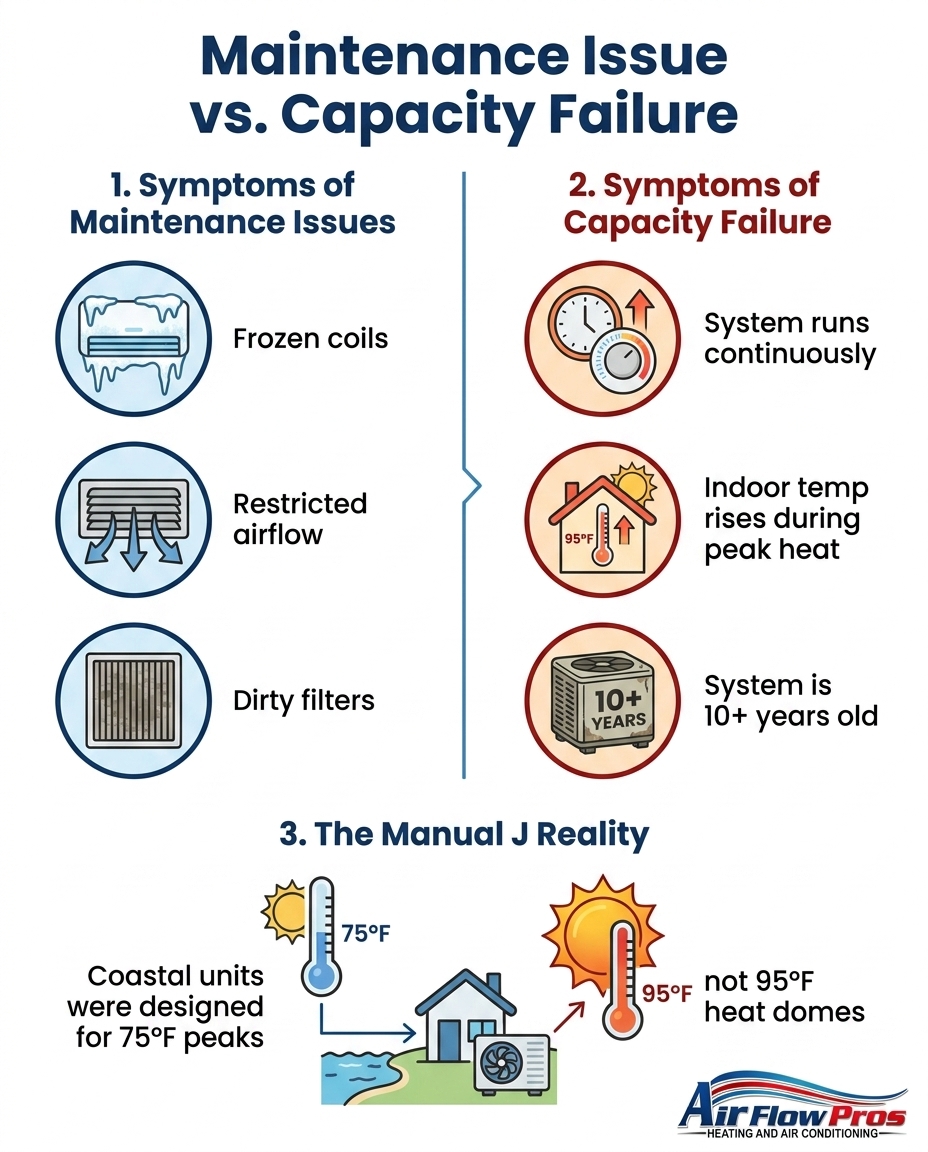
A Manual J calculation evaluates the thermal envelope of your home against the expected extreme temperatures of your specific region. Twenty years ago, the design temperature for a coastal home might have been set at a modest 75°F or 80°F. The HVAC equipment was selected to maintain a 70°F indoor temperature against that specific outdoor maximum.
Today, when a heat dome pushes outdoor temperatures to 95°F or higher, that same system is operating far outside its design parameters. It is not just a sign of a "broken" air conditioner; it is a machine being asked to perform a task it was never built to do. The mathematical gap between the old design temperature and the new reality is why your house stays warm even though the AC is running nonstop.
How Marine Environments Accelerate System Wear
Beyond the mathematical mismatch of system sizing, the local environment plays a massive role in how well your air conditioner performs. The unique climate in coastal San Francisco neighborhoods creates specific challenges for outdoor mechanical equipment. The combination of salty marine air and dense coastal fog causes accelerated corrosion on outdoor condenser coils.
Your outdoor condenser unit is responsible for releasing the heat that was absorbed from inside your home. It does this by blowing air over a series of tightly packed aluminum fins and copper coils. When salty coastal moisture coats these metals, it triggers a chemical reaction known as galvanic corrosion. Over time, the metal fins become brittle, flake away, or get coated in a thick layer of oxidation.
This corrosion acts as a dense blanket of insulation over the coils. Corroded coils lose their ability to efficiently release heat into the outdoor air. When the system cannot expel heat, the refrigerant returning to the house is still warm, severely reducing the overall cooling capacity of the unit. This specific degradation is why you might hear the system running constantly, yet feel only lukewarm air coming from your vents during a temperature spike.
Our team at Air Flow Pros constantly encounters units choked by salt and oxidation. Because the marine layer and coastal moisture have such a profound impact on outdoor HVAC components, specialized maintenance is non-negotiable. Standard inland maintenance routines often overlook the heavy chemical cleaning required to strip salt and oxidation from coastal condenser coils. Without this targeted care, the lifespan and efficiency of the unit drop dramatically.
Maintenance Glitch or Permanent Capacity Failure?
When your house is uncomfortably hot and the AC is running continuously, you need to determine if you are facing a simple maintenance issue or a permanent capacity failure. A maintenance glitch is a localized problem that restricts the system's ability to operate at its full potential. A capacity failure means the system is operating perfectly, but its "full potential" is simply no longer enough to cool the house.
Common symptoms of a maintenance failure include dirty air filters blocking airflow, failing electrical capacitors, or heavily soiled condenser coils. These issues restrict how much air the system can move or how much heat it can transfer. Another critical factor is ductwork integrity. If your ducts are torn or disconnected, you are paying to air-condition your attic. Addressing these issues through professional maintenance and optimizing your HVAC ductwork performance can instantly restore lost cooling power.
In contrast, a capacity failure presents differently. If your filters are clean, your coils are spotless, your airflow is strong, and the air coming out of the vents is cold—but the indoor temperature still rises from 72°F to 80°F during the afternoon—you have a capacity failure. The system physically cannot move heat out of the house faster than the sun is pushing it in. At this point, we generally advise our clients that it makes little financial sense to continue paying high energy bills or patching an older unit that is fundamentally undersized.
• Weak airflow from vents — Likely Cause: Clogged filter or failing blower motor — System Status: Maintenance Glitch
• Ice forming on indoor copper lines — Likely Cause: Restricted airflow or low refrigerant — System Status: Maintenance Glitch
• Strong, cold airflow but house stays hot — Likely Cause: System is undersized for current weather — System Status: Capacity Failure
• Unit shuts off repeatedly (short cycling) — Likely Cause: Overheating compressor or electrical fault — System Status: Maintenance Glitch
• System runs 15+ hours a day during peak heat — Likely Cause: Thermal load exceeds unit's maximum output — System Status: Capacity Failure
Signs of a Frozen Evaporator Coil
One of the most common maintenance failures during sudden unexpected heat waves is a frozen evaporator coil. The evaporator coil sits inside your home and absorbs heat from the air. It relies on a constant, heavy flow of warm indoor air moving across it to keep the internal refrigerant from dropping below freezing.
If that airflow is restricted by a filthy air filter, blocked vents, or a failing blower motor, the coil gets too cold. The natural humidity in the air condenses on the freezing metal and instantly turns to ice. Within hours, the coil becomes encased in a solid block of ice, completely stopping the cooling process. If you notice a sudden drop in airflow, warm air coming from the vents, or visible ice on the copper lines near your indoor unit, turn the system off immediately to let it thaw.
Safe Troubleshooting Steps for Overworked Systems
If your system begins to struggle during a major temperature spike, there are a few safe, preliminary steps you can take before calling in a professional. While you should never attempt DIY repairs on high-voltage electrical components or pressurized refrigerant lines, basic airflow management can sometimes solve the problem.
During a recent July heat wave, we responded to a local homeowner whose heat pump system became completely unresponsive on a 95-degree afternoon. Our team at Air Flow Pros dispatched a technician the same day to repair the system, getting it back online before the house overheated. Before calling our San Francisco HVAC experts, there are a few safe checks you can perform to rule out simple fixes.
1. Check and replace dirty air filters: A clogged filter is the number one cause of restricted airflow and frozen coils. Locate your return vents or the filter slot on your air handler, and replace the filter if it is gray or coated in dust. Ensure maximum airflow by using a standard pleated filter rather than an overly restrictive high-MERV filter unless your system is specifically designed for it.
2. Clear the outdoor condenser unit: Walk outside and inspect the metal box sitting in your yard. Remove any fallen branches, leaves, or overgrown vegetation blocking the sides of the unit. The system needs at least two feet of clear space in all directions to properly exhaust heat. Never run the system with a protective cover left on.
3. Verify thermostat settings and power: Check your thermostat to ensure it is set to "Cool" and that the fan is set to "Auto." If the screen is blank or unresponsive, replace the batteries. Sometimes, a slight miscalibration or a dead battery is all that stands between you and a cool home.
4. Check the electrical panel: Look at your main breaker box to see if the switch labeled for the air conditioner has tripped to the middle position. You can firmly switch it completely off, then back on. If it trips again immediately, leave it off—this indicates a serious electrical short.
If you perform these safe steps and the system still struggles or completely fails on a hot day, immediate professional intervention is required. Continuing to run a malfunctioning system during sudden unexpected heat waves can cause the compressor to overheat and permanently fail, turning a minor repair into a major replacement.
Navigating California Title 24 and Modern Retrofits
When a system has permanently failed or is fundamentally undersized, upgrading to a modern unit involves more than just swapping out a metal box. In California, all new residential HVAC installations must comply with the California Energy Commission's Title 24 building energy efficiency standards. These regulations dictate strict requirements for equipment efficiency (SEER2 ratings), duct leakage testing, and programmable thermostat integration.
Title 24 compliance ensures your new system uses significantly less electricity, but it also introduces architectural challenges when retrofitting older city homes. Modern, high-efficiency systems feature much larger outdoor condenser coils to meet these strict energy standards. A new 15.2 SEER2 condenser is often physically much taller and wider than a 10 SEER unit installed in the early 2000s.
For homes in densely packed coastal San Francisco neighborhoods, finding the physical space to accommodate these larger footprints requires customized installation plans. Zero-lot-line properties, narrow side yards, and historic facade restrictions mean that standard out-of-the-box installations rarely work. The reality of older homes requires specialized knowledge. For instance, when a homeowner in a historic zero-lot-line property recently faced a total AC breakdown during a July heat dome, our installation team had to custom-design a mounting solution for a new, larger SEER2 condenser to fit their narrow side yard while maximizing energy efficiency under load. That level of diagnostic precision and spatial awareness is required for modern summer cooling upgrades.
Highlighting the value of working with experts who understand both the regulatory requirements and the spatial constraints of the city is vital. Air Flow Pros brings specialized local expertise in crafting customized retrofitting solutions for older coastal homes. Whether it involves relocating the condenser, upgrading the electrical panel to handle modern loads, or redesigning the ductwork to pass Title 24 leakage tests, proper planning ensures your AC installation in San Francisco delivers reliable, legal, and highly efficient cooling.
Restoring Your Home's Comfort (And When to Make the Call)
Struggling with an undersized, aging unit during a heat dome is a known, solvable regional issue. You do not have to accept a hot, uncomfortable house just because the weather outside is breaking historical records. The key is recognizing the limits of your current equipment and determining whether it requires a simple tune-up or a comprehensive upgrade.
Professional diagnostics are the only way to accurately choose between a targeted repair and a customized retrofit. A trained technician can evaluate your system's current output, assess the wear caused by the marine environment, and calculate the true cooling load your home requires during sudden unexpected heat waves.
If your system is running constantly but failing to keep you comfortable, it is time to take action. Reach out to our local experts at Air Flow Pros who understand coastal HVAC challenges to start troubleshooting an air conditioner that isn't cooling. Getting professional eyes on the equipment ensures you can restore your home's comfort safely, efficiently, and permanently.
Frequently Asked Questions About Coastal Cooling Challenges
Why is my AC running but not cooling the house?
If your AC is running but the house stays warm, the system is either suffering from restricted airflow or it lacks the capacity to overcome the outdoor heat. Dirty filters, frozen evaporator coils, or a heavy layer of coastal corrosion on the outdoor unit can severely limit cooling power. A professional diagnostic can identify if the unit is failing or simply undersized for the current weather.
At what temperature does an older coastal AC struggle to cool?
Many older coastal systems were designed using historical data that planned for peak outdoor temperatures around 75°F to 80°F. When outdoor temperatures push past 85°F or into the 90s, these older units often lack the mechanical capacity to maintain a 70°F indoor temperature. They will run continuously, trying to bridge a mathematical gap they were never built to handle.
How do you fix an AC that is struggling during a heat dome?
The first step is to verify maximum airflow by replacing the air filter and clearing all debris away from the outdoor condenser unit. If the system still struggles, it requires professional attention to clean the coils, check the refrigerant charge, and assess the ductwork. If the unit is fundamentally undersized, the only permanent fix is upgrading to a properly sized modern system.
Why is my AC freezing up during a sudden heat wave?
Air conditioners freeze up when there is not enough warm indoor air blowing across the indoor evaporator coil to keep the refrigerant above freezing. This is almost always caused by a severely clogged air filter, blocked return vents, or a failing blower motor. If you see ice on the system, turn it off immediately to allow it to thaw before calling for service.
Is my AC broken or just fundamentally undersized for the heat?
If your system has clean filters, strong airflow, and produces cold air at the vents, but the indoor temperature still rises during the afternoon, it is likely undersized for the thermal load. A broken system usually exhibits specific symptoms like warm air at the vents, strange noises, or short-cycling. An HVAC professional can perform a load calculation to confirm if the unit is mathematically inadequate.
How do marine environments affect outdoor AC units?
Salty marine air and coastal fog cause rapid galvanic corrosion on the aluminum fins and copper coils of outdoor condenser units. This corrosion acts as an insulating blanket, trapping heat inside the unit and drastically reducing its ability to cool your home. Coastal units require specialized, frequent chemical cleanings to remove salt and oxidation buildup.
Service Areas

