


Why We Recommend Upgrading Your Thermostat Before Replacing Your AC

Assuming the Worst When the Cooling Stops
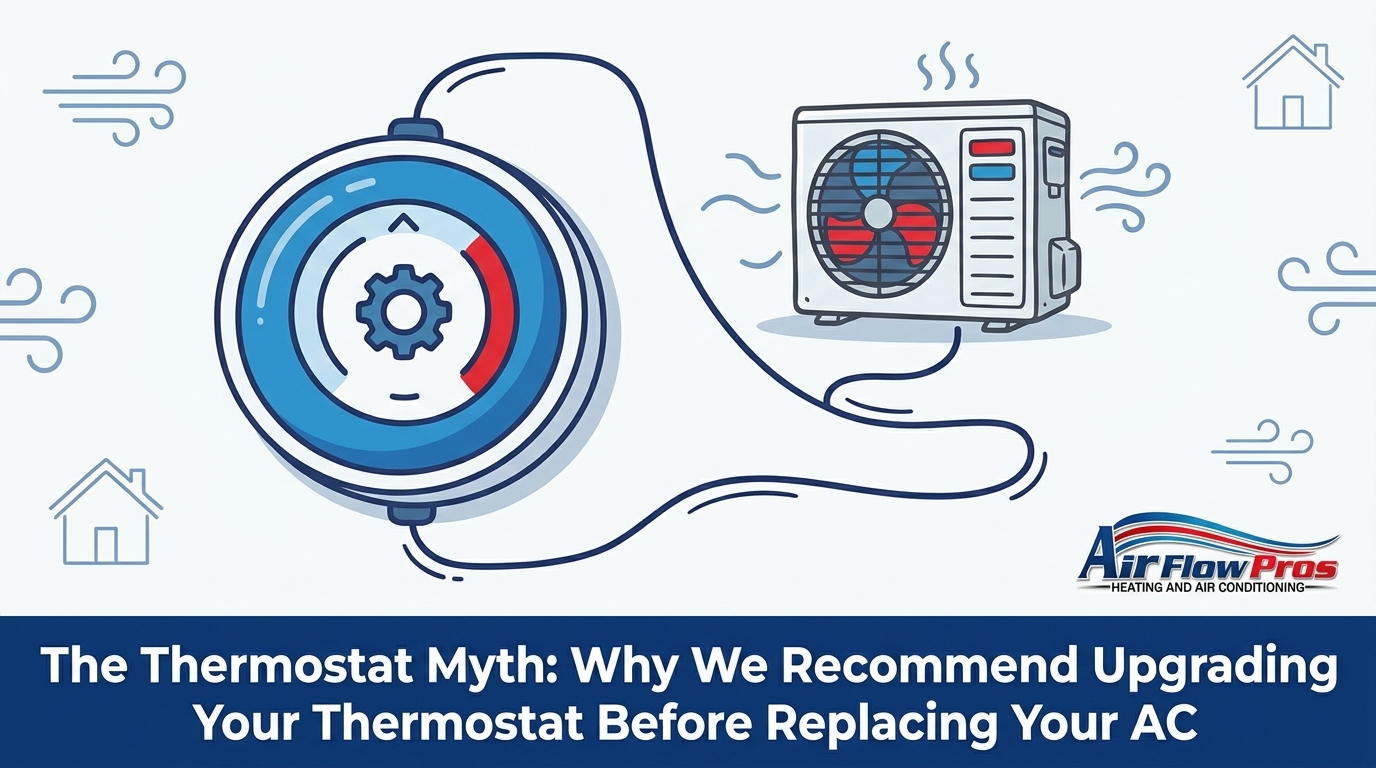
If you are wondering why we recommend upgrading your thermostat before replacing your AC, it stems from a widespread misconception that when a cooling system stops blowing cold air, the heavy machinery outside has completely failed. If you notice your home growing uncomfortably warm during the July peak summer heat, the immediate assumption is often that the compressor is dead. The panic sets in quickly. You might start wondering how long you will have to wait for a massive installation project and how much a complete system overhaul will disrupt your life.
Here is what our team at Air Flow Pros Heating & Air Conditioning tells homeowners every day: a system that refuses to cool properly does not automatically mean the outdoor unit is broken. In many cases, the problem lies entirely with the "brain" of your climate control system—the thermostat on your wall. Deciding whether to immediately request full replacement quotes or to investigate your system's control center first is a crucial decision point. By starting with the simplest explanation, you can often uncover a basic communication error that prevents unnecessary, extensive overhauls.
If you are exploring air conditioning services to resolve a sudden breakdown, scheduling a diagnostic check for a thermostat upgrade might be the smartest first step you take.
Why Your AC Unit Might Outlast Its Thermostat
The problem: Most homeowners expect their thermostat to last exactly as long as their air conditioner. When the house stops cooling, they assume both components have reached the end of their usable life simultaneously.
The cause: The reality of equipment lifespan tells a very different story. Thermostats typically have a functional lifespan of about ten years. Over time, the internal sensors degrade, dust accumulates on sensitive electrical contacts, and the wiring connections can loosen. On the other hand, a well-maintained air conditioning system can often last fifteen years or more, especially in moderate climates.
This longevity mismatch is heavily influenced by regional weather patterns. In our experience serving San Francisco microclimates, your outdoor AC unit experiences significantly less extreme wear and tear than systems running constantly in desert environments. The moderate weather means the heavy mechanical parts—the compressor, the condenser fan, and the coils—get frequent breaks. They are not battling 110-degree days for months on end.
However, the thermostat inside your home never gets a day off. Even when the air conditioner is resting, the thermostat is constantly working. It continuously monitors the indoor temperature, tracks humidity levels, and processes complex algorithms to decide when the system should cycle on next. This relentless 24/7 operation leads to faster sensor degradation.
The solution: Recognizing that age-related failures are statistically more likely to originate at the wall unit than the compressor changes how you approach a breakdown. When a ten-year-old system starts acting up, replacing the control interface is a logical, minimally invasive first step that often restores full functionality to the rest of the equipment.
Symptoms of a Failing Thermostat That Mimic a Dead AC
When outdated non-programmable thermostats begin to fail, they send erratic signals to the cooling equipment. Because the AC unit simply follows orders, it will behave exactly as if its own internal components are breaking down. Understanding these symptoms is critical for accurate troubleshooting an air conditioner with no cooling.
Our technicians recently helped a local homeowner who experienced this firsthand when their heat pump system would not turn on during a very hot summer day. They assumed the entire outdoor unit had failed under the strain. Fortunately, our team arrived for a same-day repair, identified the actual source of the communication failure, and resolved the issue so effectively that the system continues to function properly five years later. It is a perfect example of why jumping to conclusions can lead you astray.
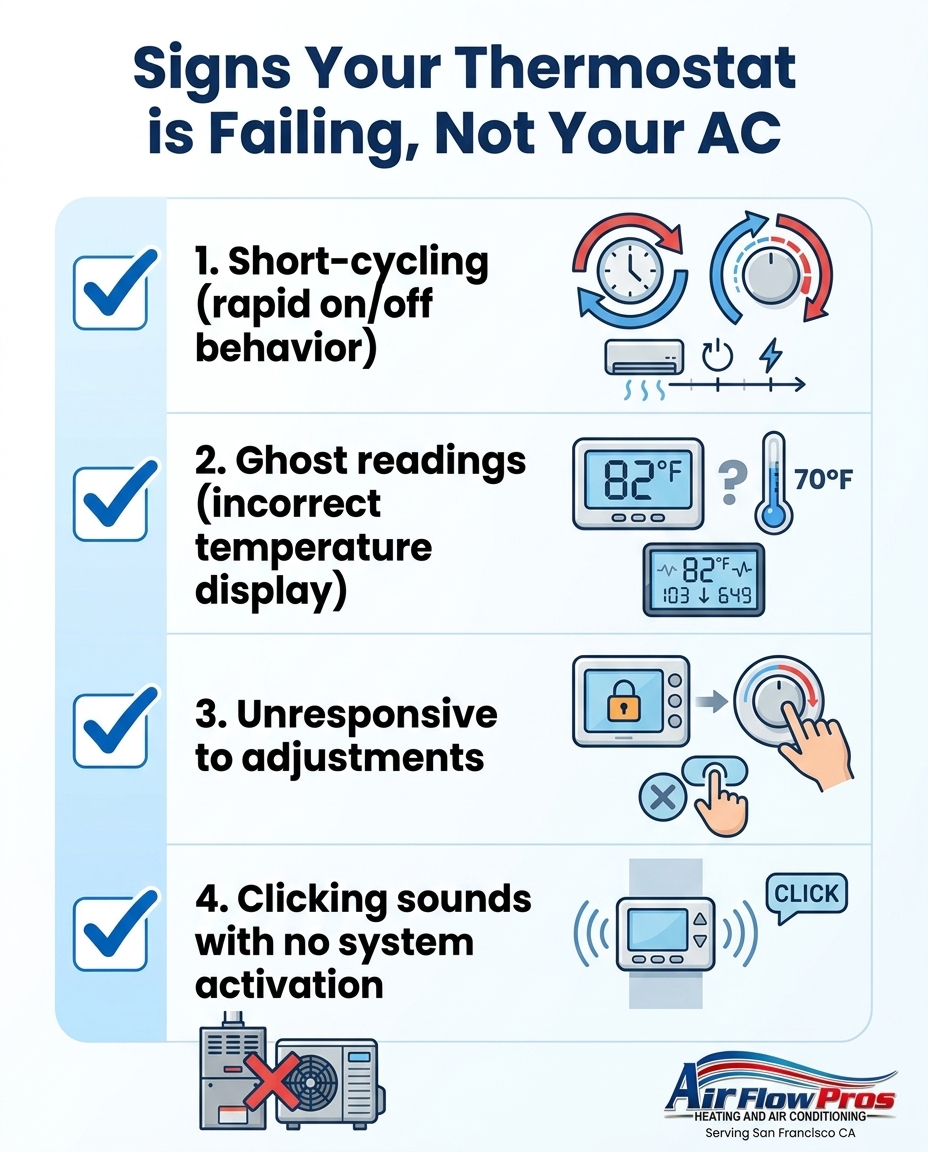
The Danger of Short-Cycling
Short-cycling occurs when your air conditioner turns on, runs for a brief period, and then shuts off before the home reaches the target temperature. It is one of the most destructive things a cooling system can do. Every time the compressor starts, it draws a massive surge of electricity and puts significant mechanical strain on the motor.
While short-cycling can be caused by a failing compressor or a refrigerant leak, we frequently find it is triggered by a faulty thermostat sensor. If the sensor misreads the room temperature, it might mistakenly believe the house has already cooled down, sending an abrupt "shut off" command just minutes after starting. This rapid on-and-off loop will quickly wear out the AC unit if left unaddressed.
Ghost Readings and Temperature Discrepancies
As the internal components of a thermostat age, they lose their calibration. This leads to "ghost readings," where the thermostat registers an incorrect ambient temperature. For example, the room might be 78 degrees, but the thermostat reads 72 degrees. Because it thinks the house is already cool, it will never send the signal to turn the air conditioner on.
Alternatively, it might read the room as much hotter than it actually is, causing the system to run constantly without ever shutting off. This erratic cooling behavior mimics a failing compressor that has lost its ability to compress refrigerant, but the actual machinery is perfectly fine—it is simply receiving bad data.
Unresponsiveness and Clicking Sounds
If you adjust the temperature on the wall and hear a distinct "click" but the air conditioner never turns on, you are hearing the electrical relay attempting to close the circuit. The click means the thermostat is trying to send the low-voltage signal to the outdoor unit. If the relay is worn out, corroded, or failing, that signal never reaches its destination.
To help you distinguish between a control issue and a mechanical failure, here is a breakdown of common symptoms:
• Rapid on/off switching — What It Feels Like: The AC runs for two minutes, stops, then starts again. — Why the Thermostat is Likely to Blame: A degraded sensor is sending premature shut-off commands.
• Room is hot, screen says cool — What It Feels Like: You are sweating, but the thermostat reads 70 degrees. — Why the Thermostat is Likely to Blame: Calibration has drifted, causing ghost readings.
• Clicking with no air — What It Feels Like: You hear a click at the wall, but the vents stay silent. — Why the Thermostat is Likely to Blame: The internal relay is failing to pass the voltage signal.
• Blank screen — What It Feels Like: The digital display is completely dark. — Why the Thermostat is Likely to Blame: Dead batteries, a blown fuse, or a failed C-wire connection.
How Sudden Heat Spikes Expose Outdated Technology
Older technology often struggles to adapt to rapid, significant shifts in ambient temperature. An aging thermostat might perform perfectly fine during mild spring weather when the temperature fluctuates gently. However, when the July peak summer heat arrives suddenly, that same device can fail to calibrate correctly when pushed to its limits.
Inside an older thermostat, mechanical components like bimetallic strips expand and contract to measure temperature. After a decade of use, this metal loses its elasticity. When a sudden heatwave hits, the strip may fail to expand accurately, causing the system to lag behind the actual temperature in the home. The sudden environmental stress exposes dormant calibration issues that were easy to ignore during the milder months.
Furthermore, how your thermostat perceives the home's temperature is heavily dependent on the air moving around it. If your vents are struggling to push conditioned air evenly through the house, the area around the thermostat might remain warm while the rest of the house freezes. This is why optimizing your ductwork performance is just as important as upgrading the control unit itself. Proper airflow ensures the sensor gets an accurate sample of the home's climate.
Transitioning from outdated models to modern smart systems is the most effective way to handle sudden environmental changes gracefully. Smart thermostats do not rely on aging mechanical strips; they use highly precise digital thermistors. They also track local weather data, allowing them to proactively adjust the cooling cycles before a massive heat spike overwhelms the house.
The Diagnostic Integrity Approach to HVAC Care
When a professional arrives at your home to evaluate a cooling failure, the order in which they test the equipment tells you everything about their diagnostic process. A trustworthy technician will always check the system's "brain" before condemning the "body."
Proper diagnostic procedures involve testing the electrical communication lines first. A technician will use a multimeter to check the voltage at the wall, ensuring the thermostat is actually sending the correct 24-volt signal to the outdoor unit. They will verify sensor accuracy, check for loose wiring in the sub-base, and test the continuity of the control wires running through your walls. If outdated non-programmable thermostats are sending scrambled signals, no amount of work on the outdoor compressor will solve the problem.
This thorough evaluation process prevents premature system overhauls. At Air Flow Pros Heating & Air Conditioning, we prioritize this level of diagnostic integrity—saving Bay Area homeowners from unnecessary expenses by identifying simple electrical and thermostat fixes instead of immediately pushing for full replacements. By proving that a minor communication error is the root cause, homeowners are spared the stress and disruption of a major installation.
If an AC replacement is genuinely required, you will have the peace of mind knowing that every simpler explanation was ruled out first. But in many cases, installing a modern smart thermostat will not only fix the immediate cooling failure but also improve the existing system's efficiency and lifespan. Smart units learn your household patterns, reduce short-cycling, and optimize run times, giving your older AC a new lease on life.
Explore a Smarter Solution Before Replacing Your System
The short answer is that a struggling air conditioner does not automatically mean a dead compressor. From ghost readings and rapid short-cycling to unresponsive relays, a failing thermostat can perfectly mimic a total system failure, especially when subjected to the unique demands of San Francisco microclimates.
Before you accept that your entire cooling setup is beyond repair, encourage a professional to evaluate your thermostat and the low-voltage communication lines. Checking the simplest explanation first is the hallmark of honest HVAC care.
If you are tired of erratic temperatures and suspect your wall unit is to blame, scheduling a thermostat upgrade can quickly restore your comfort. A clear, accurate diagnosis gives you the confidence to explore smarter control options before committing to replacing the entire cooling unit.
Frequently Asked Questions
How do I know if it's my thermostat or my AC?
The easiest way to tell the difference is to listen for the click at the wall and observe the system's response. If the thermostat clicks but the outdoor unit remains completely silent, the issue is often a communication failure between the two. Additionally, if the screen is blank or unresponsive to new inputs, the problem is localized to the control unit. A professional multimeter test can confirm exactly where the electrical signal is dropping off.
Can a bad thermostat cause AC short cycling?
Yes, a failing thermostat is one of the most common causes of short-cycling. When the internal temperature sensor degrades, it misreads the room's climate and sends premature shut-off signals to the compressor. The system turns off before the house is cool, only to turn right back on minutes later when the sensor realizes the air is still warm. Replacing the faulty sensor usually resolves this damaging loop.
Will a new thermostat make my AC run better?
A new thermostat can significantly improve how efficiently your existing air conditioner operates. Modern smart models use precise digital sensors and advanced algorithms to optimize cooling cycles, reducing unnecessary wear and tear on the compressor. By learning your schedule and adjusting for local weather data, a new control unit ensures your AC only runs exactly when it needs to.
Can a bad thermostat ruin an air conditioner?
If left unaddressed for too long, a malfunctioning thermostat can absolutely cause severe damage to your cooling equipment. The primary danger comes from short-cycling, which forces the compressor to start and stop rapidly. This constant surging draws excessive electricity, overheats the motor, and can eventually cause the compressor to burn out completely.
Why does my thermostat click but the AC won't turn on?
That clicking sound is the internal relay attempting to close the electrical circuit to send a "turn on" signal to the air conditioner. If the AC does not respond, it means the signal is not reaching the outdoor unit. This could be due to a broken wire in the wall, a blown fuse in the air handler, or a failed contactor outside, all of which require a professional diagnostic to trace.
How long do thermostats typically last compared to AC units?
Thermostats generally have a reliable lifespan of about ten years, while a well-maintained air conditioning unit can last fifteen years or more. Because the wall unit operates continuously to monitor the indoor climate, its sensors and electrical contacts often wear out before the heavy mechanical components outside do. This is why replacing the control unit is frequently required at least once during the lifespan of your cooling system.
Service Areas

