


Managing Indoor Air Quality During California Wildfire Season

When July Smoke Drifts Indoors: The Bay Area's Summer Challenge
As the July peak summer wildfire season arrives, managing indoor air quality during California wildfire season becomes a daily battle for local homeowners. You check the air quality index, close all the windows, and stay inside, yet that distinct campfire smell still finds its way into your living room. The San Francisco Bay Area faces a unique environmental challenge this time of year. Coastal fog often rolls in and mixes heavily with drifting wildfire smoke, creating a dense, lingering particulate mass that easily penetrates even well-built homes. Relying on passive defense—simply shutting doors and windows—is rarely enough to keep your living space comfortable. Protecting your home requires active, mechanical intervention.
Understanding how your HVAC system handles this seasonal threat is the first step toward better indoor air quality.
The Illusion of a Sealed Home
Many homeowners believe that a closed house is a sealed house. The reality is quite different. Every home naturally breathes, exchanging air with the outside environment through microscopic gaps around window frames, door jambs, and rooflines. When the dense fog-and-smoke mixture settles over your neighborhood, natural barometric pressure changes force that contaminated air indoors.
This natural air exchange explains why you can still smell smoke hours after tightly locking up the house. Because the outdoor air pressure is constantly shifting, your home acts like a slow sponge, absorbing the surrounding environment. Without a mechanical system actively scrubbing the air as it circulates, those contaminants settle into your upholstery, carpets, and ductwork. Fighting back requires using your central heating and cooling system as an active filtration tool, rather than just a temperature control device.
Why Standard Filters Fail Against PM2.5 Wildfire Particulates
To understand why your house smells like a campfire, you have to look at the microscopic nature of the threat. Wildfire smoke is primarily composed of PM2.5 particulates. These are incredibly fine particles that measure 2.5 microns or less in diameter—roughly 30 times smaller than a single strand of human hair. Because they are so small, they behave more like a gas than typical airborne dust.
Standard 1-inch fiberglass air filters are simply not designed for this level of filtration. Those cheap, see-through filters are affectionately known in the industry as "boulder catchers." Their sole purpose is to stop large debris, like pet hair and heavy lint, from damaging the internal blower motor of your HVAC unit. When a cloud of PM2.5 smoke hits a fiberglass filter, the microscopic particles pass right through the wide mesh and blow directly into your living space.
If you are constantly wiping ash off your furniture despite running your air conditioner, consulting with indoor air quality specialists can help you identify exactly where your current filtration is falling short.
The Real-World Impact of PM2.5
Data from the Bay Area Air Quality Management District (BAAQMD) consistently shows severe spikes in PM2.5 levels during summer smoke drift events. These particles are not just a nuisance; they are a recognized health hazard. Because they are microscopic, PM2.5 particles easily bypass the human body's natural respiratory defenses and can enter the bloodstream directly.
• Human Hair — Average Size (Microns): 50 - 70 — Standard Filter Capture Rate: 100%
• Household Dust/Lint — Average Size (Microns): 10 - 20 — Standard Filter Capture Rate: High
• Pet Dander — Average Size (Microns): 5 - 10 — Standard Filter Capture Rate: Moderate
• Wildfire Smoke (PM2.5) — Average Size (Microns): 2.5 or less — Standard Filter Capture Rate: Near Zero
When the San Francisco Bay Area is blanketed in smoke, relying on a basic filter is like trying to catch sand with a tennis net. Upgrading your filtration media is necessary, but it must be done with careful attention to your system's mechanical limits.
Balancing High-MERV Filtration with HVAC Airflow Limits
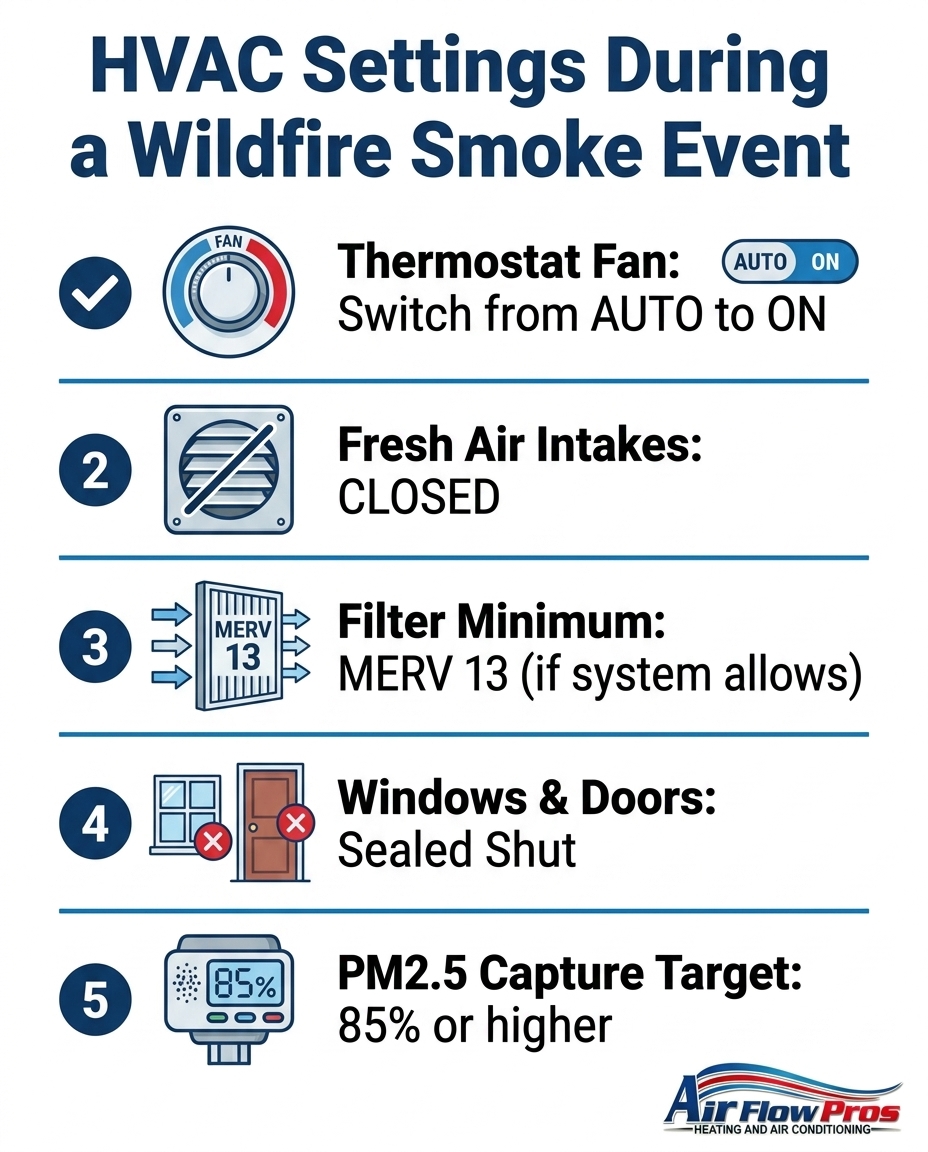
The standard recommendation from ASHRAE (The American Society of Heating, Refrigerating and Air-Conditioning Engineers) during a smoke event is to use HEPA and MERV 13+ filters. A MERV 13 rating is the recognized baseline for capturing at least 85% of PM2.5 smoke particles. However, upgrading your filter is not as simple as buying the most expensive option at the hardware store and sliding it into your return grille.
High-efficiency filters are incredibly dense. While that density is great for trapping microscopic smoke particles, it also creates significant resistance against the air trying to pass through it. This resistance is known as static pressure. Think of it like trying to breathe while running: breathing through your mouth is easy, but breathing through a narrow coffee stirrer is exhausting. When you install a dense filter, you are forcing your HVAC blower motor to "breathe through a stirrer."
The Danger of High Static Pressure
If your system is not rated to handle that level of resistance, the results can be disastrous. The blower motor will have to work twice as hard, leading to overheating and premature burnout. Furthermore, because less air is moving over the indoor evaporator coil, the coil can literally freeze solid into a block of ice, shutting down your cooling system right when you need it most.
Airflow restrictions are a common but hidden issue. For example, one local homeowner reached out last winter regarding duct problems that were severely restricting their system's airflow. Professional service was required to address and solve the issue, restoring proper circulation. If a system is already struggling with hidden airflow blockages like this, adding a highly restrictive air filter will quickly push the blower motor to the point of failure.
This is where localized expertise matters. A professional assessment ensures you can safely retrofit specialized filtration systems to combat heavy smoke without sacrificing essential summer cooling performance. Upgrading to dedicated air cleaners requires matching the media density to your specific blower capacity, ensuring you get clean air without destroying your equipment.
Essential Thermostat and Damper Settings for Smoke Events
When a 'Spare the Air' alert is issued for the San Francisco Bay Area, you need to take immediate action at your thermostat. Having the right filter installed is only half the battle; you also need to configure your system to actively scrub the air rather than passively waiting for the temperature to rise.
Most homeowners leave their thermostat fan setting on "AUTO." In this mode, the blower fan only turns on when the air conditioner is actively cooling the house. Once the target temperature is reached, the system shuts down, and air stops moving through your filter. During a severe smoke event, you want continuous filtration.
Step-by-Step Configuration
1. Switch the Fan to 'ON': Change your thermostat fan setting from 'AUTO' to 'ON'. This forces the blower motor to run continuously, pulling the smoky indoor air through your high-efficiency filter 24 hours a day, constantly scrubbing the environment.
2. Locate and Close Fresh Air Intakes: Many modern HVAC systems feature a fresh air intake damper designed to pull outdoor air inside to prevent staleness. During a wildfire, this damper acts as a smoke vacuum. You must ensure this damper is completely closed.
3. Maintain a Moderate Temperature: Run your air conditioning at a comfortable, moderate setting. Cooling the air helps reduce indoor humidity, which can sometimes make smoke odors feel heavier and more oppressive.
4. Seal the Perimeter: Double-check that all windows and exterior doors are tightly closed and locked. Locking windows often engages the weatherstripping more firmly than simply shutting them.
By taking control of these settings, you turn your central air system into a whole-home air purifier.
The Hidden Threat: How Leaky Ductwork Pulls Smoke Inside
Sometimes, despite keeping windows closed and installing a high-quality filter, the smell of smoke persists. When this happens, the culprit is often hidden right above your head or beneath your feet: leaky ductwork. During the July peak summer wildfire season, compromised ducts become a primary entry point for outdoor pollutants.
Most homes feature ductwork that runs through unconditioned spaces, such as hot attics or damp crawlspaces. These areas are completely exposed to the outdoor air. If your return ducts—the wide pipes that pull air from your house back to the furnace—have cracks, loose joints, or degraded tape, they create a severe problem known as negative pressure.
The Physics of Negative Pressure
When your blower motor turns on, it creates a powerful suction inside the return ducts. If those ducts are sealed properly, they only pull air from inside your living room. But if there is a leak in the attic, the system acts like a vacuum cleaner, actively sucking the smoky, contaminated attic air directly into your HVAC system. From there, the blower pushes that smoke straight through your supply vents and into your bedrooms.
No air filter in the world can fully compensate for a system that is actively pumping outdoor smoke into the house. Addressing these hidden leaks by optimizing HVAC ductwork performance is often more effective than simply buying a thicker filter. Sealing the ductwork ensures that the only air your system circulates is the air already inside your home.
Upgrading to Whole-Home Filtration for Lasting Relief
When the smoke gets overwhelmingly thick, many homeowners rush to buy portable room air purifiers. While a portable unit is excellent for keeping a single bedroom clean overnight, it lacks the mechanical power to protect an entire house. Portable units are limited by their small fans and limited square footage ratings. To protect your entire living space, you need a solution integrated directly into your central HVAC system.
Whole-home filtration systems are designed to handle massive volumes of air without restricting the flow your air conditioner needs to operate efficiently. These systems provide a permanent defense against HEPA and MERV 13+ filters' typical static pressure problems.
Media Cabinets vs. Bypass HEPA Systems
There are two primary ways to upgrade your central filtration:
• Deep-Pleated Media Cabinets: Instead of a 1-inch filter, a professional installs a wider cabinet that holds a 4-inch or 5-inch thick filter. Because the filter media is deeply folded like an accordion, it offers massive surface area. This allows it to capture microscopic smoke particles without choking the airflow.
• Bypass HEPA Systems: For the ultimate protection, a bypass system is installed alongside your main ductwork. It uses its own dedicated fan to pull a portion of your home's air out of the return duct, scrub it through a true hospital-grade HEPA filter, and push it back into the airflow. Because it runs on a separate loop, it adds zero static pressure to your main blower motor.
Investing in permanent indoor air quality products provides year-round benefits, tackling spring pollen and pet dander just as effectively as late-summer smoke drift.
Your 'Spare the Air' Day HVAC Checklist
When the sky turns orange and the air quality index plummets, having a reliable routine makes all the difference. During the July peak summer wildfire season, keep this quick-reference checklist handy to protect your indoor air quality immediately.
• Monitor Local AQI Daily: Check your local air quality index every morning. When levels enter the unhealthy range, lock all windows and doors to ensure the tightest possible seal on your home's envelope.
• Adjust Thermostat Settings: Verify that your thermostat fan is set to the 'ON' position for continuous air scrubbing, rather than 'AUTO'.
• Close Fresh Air Dampers: Ensure any mechanical ventilation bringing in outside air is temporarily disabled or closed off.
• Verify Filter Condition: Check that a clean, appropriately rated high-MERV filter is installed. A dirty filter combined with heavy smoke will quickly choke your system.
• Plan for Post-Season Replacement: Wildfire smoke contains heavy resins and oils. When the smoke clears and humidity rises, this ash can harden like concrete on your filter media. Always schedule a fresh filter replacement immediately after the fire season ends.
Ensure Your System is Ready for the Next Smoke Event
Surviving the wildfire season comfortably requires more than just closing your windows; it demands proactive mechanical preparation. By understanding how to balance airflow with proper HEPA and MERV 13+ filters, you can turn your central air system into a powerful shield against outdoor pollution. Don't wait until the smoke is already inside your living room. Take the time to assess your filtration capabilities and upgrade your system now, ensuring you have a clear, actionable defense ready before the next wave of smoke hits.
Frequently Asked Questions
Should I run my AC when it's smoky outside?
Yes, running your central air conditioner is generally safe and highly recommended during a smoke event. Most standard split-system air conditioners do not pull fresh air from the outside; they simply recirculate the air already inside your home. Running the AC helps push that indoor air through your system's filter, actively scrubbing out particulate matter while keeping you cool and comfortable.
What MERV rating is best for wildfire smoke?
A MERV 13 rating is widely considered the best baseline for effectively capturing wildfire smoke in a residential HVAC system. Filters with this rating can trap at least 85% of microscopic PM2.5 particles. However, you must ensure your specific blower motor is powerful enough to handle the increased air resistance of a MERV 13 filter without overheating or freezing the evaporator coils.
Does my HVAC bring in outside air during a fire?
A standard residential heating and cooling system does not bring in outside air; it recirculates indoor air. However, some modern homes are equipped with specific fresh air intakes or mechanical ventilators (like ERVs or HRVs) designed to introduce outdoor air. If your home has one of these specific ventilation features, you must manually turn it off or close the damper during a wildfire to prevent smoke from being pulled inside.
How can I improve indoor air quality during a wildfire?
The most effective strategy is to seal your home tightly and set your thermostat fan to the "ON" position so it runs continuously. Pair this continuous circulation with the highest MERV-rated filter your system can safely handle. Additionally, utilizing portable HEPA air purifiers in frequently used rooms like bedrooms can provide an extra layer of targeted filtration.
Can high-efficiency filters damage my older furnace or air conditioner?
Yes, installing a high-efficiency filter in an older system that wasn't designed for it can cause significant damage. Dense filters create high static pressure, forcing the blower motor to work much harder to pull air through the material. This severe airflow restriction can lead to burned-out blower motors, overheated heat exchangers, and frozen air conditioning coils.
Service Areas

